
Table of Contents
The Geographical Miracle of Darjeeling Himalayan Terroir
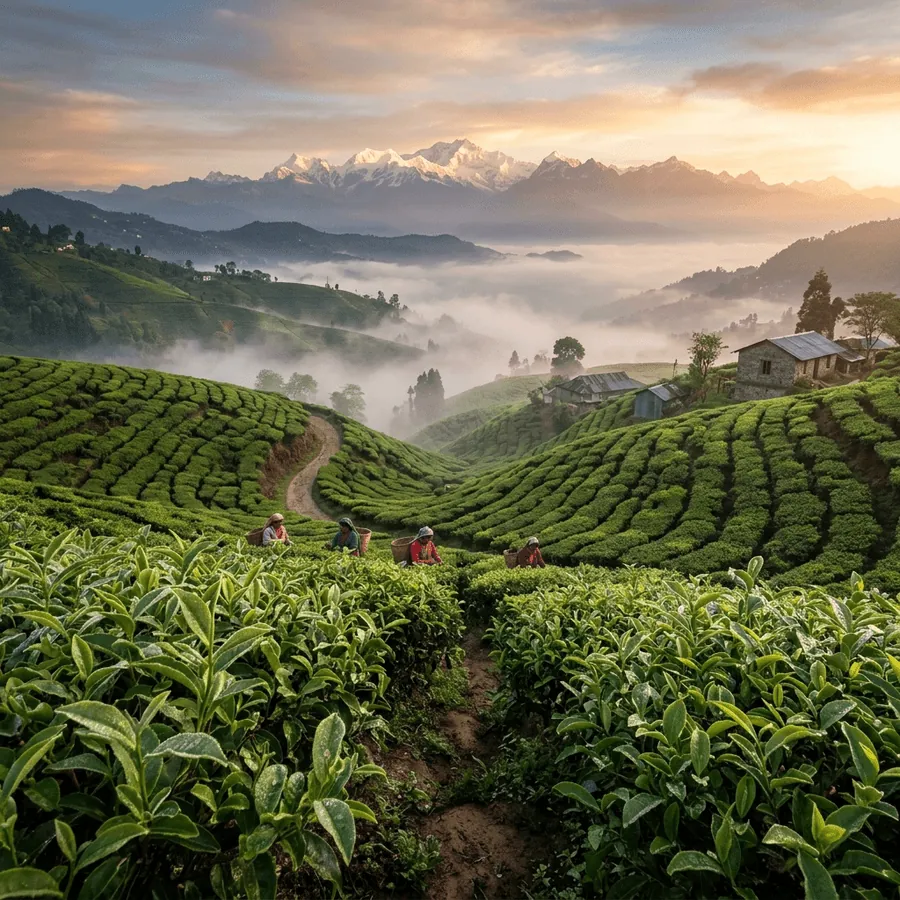
Perched between 2,000 and 7,000 feet above sea level under the watchful gaze of Mount Kanchenjunga, the 87 registered tea gardens of Darjeeling produce some of the most revered agricultural harvests on planet Earth. Awarded India's very first Geographical Indication (GI) status in 2004, authentic Darjeeling tea cannot be replicated anywhere else in the world.
The secret lies in the unique microclimate: thin Himalayan mountain air, steep drainage slopes, alkaline soil, intense daytime ultraviolet sunshine, and cold evening mountain mists that cause the tea bushes (predominantly ancient Chinese Camellia sinensis var. sinensis cultivars) to grow exceptionally slowly, concentrating complex aromatic esters in the tender leaf buds.
First Flush: The Golden Spring Whisper
Harvested between late February and mid-April following winter dormancy, the First Flush consists of the very first tender two-leaves-and-a-bud shoots. Because the mountain air remains chilly, the plucks undergo minimal oxidation (around 20–30%).
The liquor is pale golden-champagne, intensely aromatic with notes of spring flowers, green peach, fresh dew, and a crisp, lively briskness resembling dry white wine.
Second Flush: The Amber Muscatel King
Harvested in late May through June before the arrival of the heavy monsoon rains, the Second Flush is the undisputed pinnacle of orthodox tea production. During this brief window, tiny green leafhopper insects (Empoasca flavescens) nibble the tender tea shoots. In response, the tea bush activates its natural defense mechanisms, synthesizing terpene alcohols and aromatic glycosides.
When processed with 70–80% oxidation, the resulting tea produces a gorgeous, deep amber-copper infusion famous for its distinct "Muscatel" character—a luscious, complex flavor reminiscent of sweet Muscat dessert grapes, roasted raisins, and mountain wildflowers.
First Flush vs Second Flush Comparison
| Characteristic | First Flush (Spring Harvest) | Second Flush (Summer Harvest) |
|---|---|---|
| Harvest Period | Late February – Mid April | Late May – End of June |
| Oxidation Level | Light (20% – 35%) | Medium-Full (70% – 85%) |
| Cup Liquor Color | Pale luminous gold to light champagne | Deep glowing copper-amber |
| Dominant Flavor | Crisp floral, raw peach, vegetal freshness | Ripe muscat grape, roasted nuts, wild honey |
| Best Enjoyed | Pure, without milk, afternoon contemplation | Pure or with a slice of lemon; pairs with cheese |
How to Brew Orthodox Darjeeling Without Bitterness
Orthodox Darjeeling leaves are delicate and should never be boiled aggressively like CTC chai:
- Heat water to 85°C – 90°C (never rolling 100°C boil).
- Use 2 grams (1 rounded teaspoon) of whole leaves per 200ml cup.
- Steep covered in a ceramic or glass teapot for exactly 3.5 minutes.
- Strain completely; never leave the leaves sitting in warm water, which draws out excessive tannins. Sip slowly to experience the evolving floral finish.